Ravana's ten heads: what the effigy really stands for
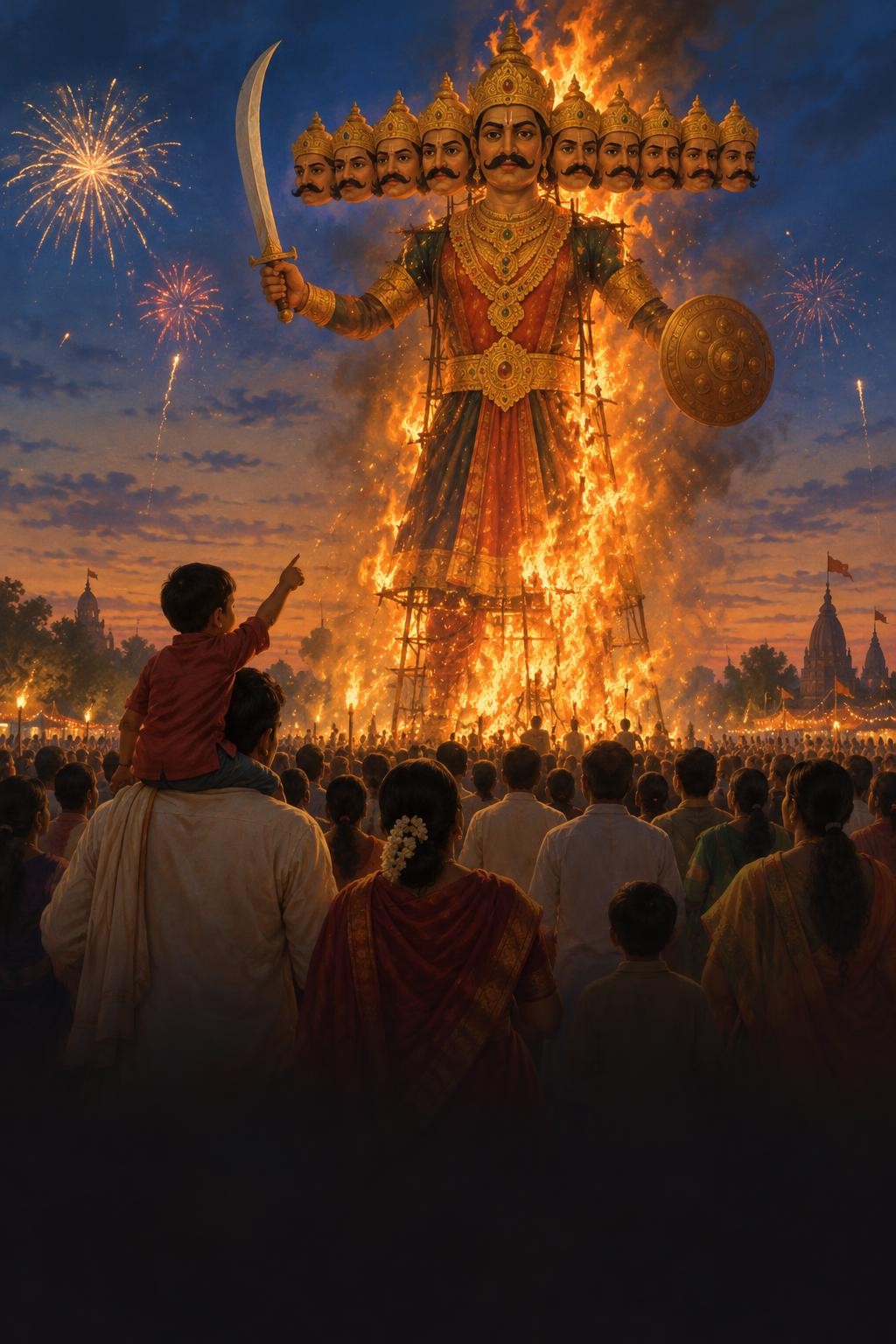
Ravana's ten heads: what the effigy really stands for
The short answer
Dussehra 2026 falls on Tuesday, 20 October (Ashwin Shukla Dashami). Most families mark it on the 20th; some regional calendars following the sunrise tithi observe it on 21 October, follow your family's or local temple's panchang, because both are kept in good faith. The afternoon is the active window: the aparahna puja period runs roughly 1:14 PM to 3:32 PM IST, and the vijay muhurat for Delhi is about 2:00 PM to 2:46 PM (a few minutes earlier or later depending on your city). Three things actually matter today: the afternoon puja (Aparajita, shami, and your tools or books), the evening Ravan Dahan if you can reach one, and the one inner failing you decide to let go of.
Step by step
- Wake and clean the house. Sweep and mop before the puja begins; this is the close of Navratri and the space should feel fresh.
- Gather what you need in the morning. Pull out the shami leaves or apta leaves if you have them, flowers, incense, a lamp, and any tools, books, or instruments you want to worship. If you have a Navratri kalash still set up, keep it ready.
- Clean and arrange your tools or books. Wipe them down, place them on a clean cloth, and put a tilak on each. Mechanics, musicians, students, drivers, everyone includes what they work with.
- Do the aparahna puja between about 1:14 PM and 3:32 PM. Light the lamp, offer flowers, and do a simple prayer to Aparajita (the unconquered goddess) and to the shami plant or a branch if you have one. If you have neither a plant nor leaves, a picture of the goddess and a sincere prayer is enough.
- Sprinkle the Navratri kalash water through the house and offer the jaware (barley shoots), some families keep a shoot behind the ear or in their hair for the day.
- Exchange shami or apta leaves with family and neighbours saying the traditional prayer: Shami shamayate papam, shami shatru-vinashini. Arjunasya dhanurdhari, Ramasya priyadarshini. This is the custom in Maharashtra and Karnataka especially, but anyone can do it.
- In the evening, go to the Ramlila ground or watch the Ravan Dahan if one is nearby. As the effigy burns, take a moment, not to cheer at a villain, but to name the one thing in yourself you want to burn with it.
- If you are in Bengal, the day centres on Durga Visarjan and sindoor khela among married women; the Ravan Dahan is less central there.
- Before bed, if you are in north India and spotted a Neelkanth (Indian roller bird) during the day, that is considered auspicious, note it if you saw one.
What to offer
For the goddess and shami puja, items from an ordinary kitchen or garden:
- Fresh flowers (marigold, hibiscus, or whatever is in season)
- Whole rice (akshat)
- A small lamp with ghee or oil
- Incense sticks
- A piece of jaggery or a fruit as prasad
- Shami or apta leaves, or neem leaves if those are all you have
For ayudha or shastra puja, what goes on the cloth alongside your tools:
- A pinch of turmeric and kumkum for the tilak
- A few flower petals scattered over the items
- A small coconut if available, placed in front
- Akshat (whole unbroken rice) sprinkled over everything
If this is you
Someone doing this at home for the first time
You do not need a pandit or a full set of ritual items. Set up a clean space, place whatever you have, a lamp, a flower, a fruit, and do the puja during the afternoon window. The intention is to close Navratri with gratitude and begin something new; this day is one of the sade teen muhurat, meaning it is so auspicious that any new beginning you make today needs no separate auspicious time.
A working person with half an hour today
Do the puja on your lunch break or just after. Wipe your laptop, your tools, or your desk, place a small tilak on them, light one incense stick, and say a short prayer of thanks. If you can step outside at 2:00 PM for even five minutes during the vijay muhurat, that is enough. Watch the Ravan Dahan on your phone in the evening if you cannot attend in person.
A family with children who want to understand it
Tell them Ravana was genuinely brilliant, he knew the Vedas, he composed the Shiva Tandava Stotram, and he was a devoted worshipper of Shiva. Then ask them: if someone that brilliant still fell, what brought him down? Let them guess. Then explain the ten heads as ten habits that cloud good judgment, and ask each child to name one they want to work on. That conversation is the real ritual.
Someone living abroad with no Ramlila nearby
Light a diya at the vijay muhurat time in your time zone (convert from IST). Do the ayudha puja with your laptop, your car keys, your musical instrument, whatever you work with. In the evening, find a Ravan Dahan livestream; many temples in India broadcast them. Write down the one failing you want to release this year, and burn that piece of paper safely. The geography does not change what the day is for.
Why this day matters
Dussehra holds two victories at once. The first is Rama's defeat of Ravana at Lanka, as told in the Valmiki Ramayana, the word Dussehra is read as dasha-hara, the defeat of the ten-headed one. The second is Durga's victory over the buffalo demon Mahishasura after nine days and nights of battle, as told in the Devi Mahatmya of the Markandeya Purana. Both victories land on the same tenth day, and both are about the same thing: the moment when sustained effort finally breaks through.
Ravana is not a simple villain in the tradition. He was a scholar of the first order, master of the four Vedas and six shastras, which is one reading of his ten heads, ten repositories of knowledge. He composed the Shiva Tandava Stotram, still recited today. Temples in parts of India honour him. The tradition holds both things at once: he was great, and he fell.
The moral reading of the ten heads gives us ten failings, lust, anger, greed, delusion, pride, envy, selfishness, injustice, cruelty, and ego. His fall did not come from ignorance. It came from one desire he would not release, even when everyone around him told him to. That is the uncomfortable part of the story: the problem was not that he did not know better.
The Pandavas hid their weapons in a shami tree for the final year of their exile and took them down on this very day to face the Kaurava army that had raided King Virata's cattle (Virata Parva, Mahabharata). The shami leaf exchange and the Aparajita puja both carry the same idea: you have done the inner work during Navratri, and now you step forward. Vijayadashami is the crossing of the threshold.
Common questions
Which date should I follow, 20 or 21 October 2026? The Dashami tithi begins at about 12:50 PM IST on 20 October and ends at about 2:11 PM IST on 21 October. Most calendars observe Dussehra on 20 October because the vijay muhurat falls clearly within it. Some regional calendars that follow the sunrise tithi mark it on 21 October. Follow your family's panchang or ask your local temple, both dates are observed in good faith across India.
Do I have to fast today? Dussehra is not primarily a fasting day the way Ekadashi or Karva Chauth is. Practice varies by family and region. Many people eat normally and focus on the puja and the evening Ravan Dahan. If your family fasts, follow that; if not, there is no standard rule requiring it.
Can I start something new today even without a separate muhurat? Yes. Vijayadashami is one of the sade teen muhurat, days considered so inherently auspicious that new work, a purchase, starting a business, or a child's first lesson need no separately calculated muhurat. The day itself is the muhurat.
What is Vidyarambham and who does it? Vidyarambham is the initiation of young children into letters, their first formal writing lesson. It is observed in Kerala and parts of south India on Vijayadashami. If you have a young child and follow this tradition, a priest or elder guides the child's hand to write the first letters, often in a tray of rice or sand. If you are not from a community where this is customary, it is not something you need to add; it is a regional practice, not a pan-India requirement.
Carrying something heavier?
Ask Krishna about your own situation — no judgment, just a real conversation. It's free to start.
Talk to Krishna →